Seriously. We know this. Because they’ve all said so.
Except the former CIA guy thinks that they will oppose Trump. (there is context, but still….)
“You’ve Been Around for 13 Months – We’ve Been Around Since 1908. We’re Going to Win”
Watch:

Except the former CIA guy thinks that they will oppose Trump. (there is context, but still….)
“You’ve Been Around for 13 Months – We’ve Been Around Since 1908. We’re Going to Win”
Watch:
God will no longer be referred to as He or Him in the Episcopal Church Diocese of Washington, D.C., which passed a resolution last week barring all use of masculine pronouns when referring to the Almighty. They will be updating their Book of Common Prayer as a result.
“If revision of the Book of Common Prayer is authorized, to utilize expansive language for God from the rich sources of feminine, masculine, and non-binary imagery for God found in Scripture and tradition and, when possible, to avoid the use of gendered pronouns for God,” the resolution stated.
I really haven’t anything else to say…..We, as a culture, are driving full throttle over the cliff and the brakes don’t work.
Men are no longer willing to meet with women because of #MeToo.
It’s gonna get worse. Men aren’t gonna mentor women, nor teach them. College professors will no longer help women get ahead, nor tutor those with outstanding potential. Training opportunities will be fewer, as men will refuse to train women because of fear of accusations now or 20 years later. Where will the attorneys, doctors, pilots, engineers,chemists, mathematicians, physicists, etc come from? There aren’t nearly enough women teachers in those fields……Men soon won’t teach you or your daughters for fear of accusations.
There will be fewer internships for women, most of whom will have to work with men. Male students will also soon choose not to work with women. Segregation will happen. Read the linked article: even major corporations are suggesting men not ever be alone with women, singly or in groups.
Women will be set back 20 or 30 years because of this. Opportunities for learning and advancement will dry up rapidly. Women will be viewed as dangerous to work with (and be treated as if y’all really CAN’T be let out without a male keeper, ’cause y’all apparently can’t defend yourselves…….) because of this “movement”.
Bet on it. It is happening now, and more will be forthcoming. The damage will soon become nearly irreversible (at least in your lifetime).
Ladies, you need to stop this movement before it does more damage to YOU and your Daughters….and only women can stop it. You women, all of you that are nodding your heads, need to get off the bandwagon of #MeToo, stop thinking with your emotions and start thinking with your brains and wake the hell up and put a stop to this. Yes, I know you are emotionally focused to follow other women. Yes, I know you like to follow trends and fashion. THIS IS MORE IMPORTANT THAN THAT. For the future, yours and your daughters and granddaughters, WAKE UP, shake it off and speak up (loudly!) and put a stop to this….GET YER SISTERS TO DO THE SAME…..If you don’t, you won’t like how the future will look.
For those of you who donated, in any amount, I too thank you. She is good people.
If you haven’t, why not?
Toss what you spend a week on coffee (or smokes) her way. It’ll help a LOT and will go a ways toward balancing the scales….she has helped so many folks.
And for those who can’t. or won’t help, at least keep her in your thoughts and prayers.
Taste.
Tip yer waitress, I’ll be here all week….
Read HERE.
My condolences to Angel and her Family. If ya got a minute, and are so inclined, say a prayer to whomever you pray. Or at least think good thoughts her way. She’s good people, and doesn’t deserve this.
Ken Lane (Wirecutter), AKA Knuckledraggin, is doing a fundraiser, ’cause this couldn’t have come at a worse time for the family.
You can find out how to donate HERE.
I tossed a Benjamin her way (who needs ammo this month?), but even $5 or $10 will help.
We often help many we don’t know, who aren’t part of ourTribe.
Let us come together hand help one of our own.
So I go to load some .45 ACP for a new shooter that I am taking to the range on Friday.
I tumbled some range pickup brass, load 2 tubes with primers, pull out a box of plated 230 grain, check the powder levels, lube the 550 and commence to loading.
about 10 cases in, I get one where the primer just will not go back in. …Odd, but hey, this is brass of no certain pedigree, so I pull the case out and toss it into the trash.
About 10 cases later, I get another. Then another.
Damn, this is affecting my rhythm.
When I got the 4th one, I looked at the primer pockets to see if they were staked, or had burrs, or what was causing them to not load primers. They were all the same headstamp.
I began checking the base of each cartridge I picked up out of the bin before loading it into the press (I usually just get into the rhythm….pick up a case, load the case with my right hand, put a bullet in the primed and loaded case on the other side of the press with y left hand, pull lever, rinse, repeat…..
Having to look at each piece of brass slows me down, but I soldier on. I mean, I can usually load about 250 .45 in an hour, this is slowing me down to about half that.
It wasn’t until I was done that I noticed what was different about the uncooperative brass….
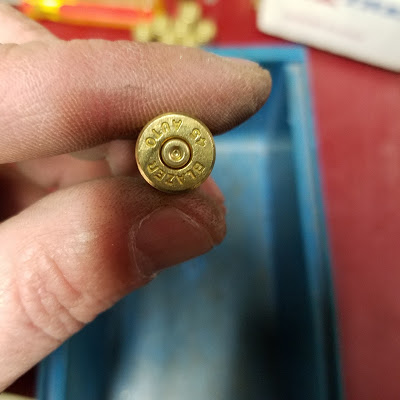
Not obvious, izzit?
How about if I show you a case that WILL take primers?
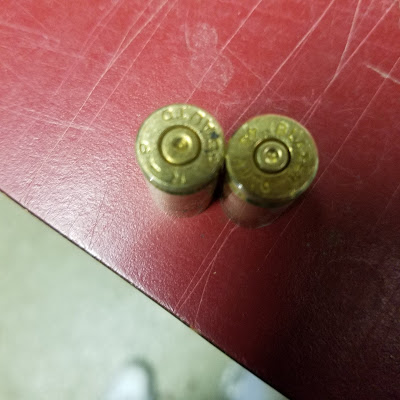
Yeah, Who ever heard of a .45 ACP case that takes SMALL Pistol primers?
Now I got about 3000 cases to sort through.
Police: Attempted Lincoln Square home invader fatally shot by accomplice.
Just sayin’
Not even subtle about it either.
At first I thought it was a parody, but apparently it is real.